Introduction to Advancing Dental Care
Most people picture a loud drill and an uncomfortable chair when they think of the dentist. That picture is changing fast. Advancing dental care today looks very different from what it was ten years ago.
Your dentist can now spot a cavity before it hurts. They can rebuild a broken tooth in one visit. They can even check your gums over a video call. These are not future promises. They are happening right now in dental clinics around the world.
This guide walks you through every part of this shift. You will learn about the tools dentists use, how training is improving, and what advancing dental care will look like for you in the years ahead.
Advancing Dental Care Through Modern Technology
Walk into a modern dental practice and the first thing you notice is how calm it feels. No grinding sounds before you sit down. No trays full of messy putty. Just clean tools, bright screens, and a dentist who pulls up your full mouth scan in seconds.
Technology is now the engine behind advancing dental care. It speeds up appointments, cuts down on mistakes, and removes a lot of the fear that patients used to bring through the clinic door. Three changes stand out above the rest.
Digital X-Rays and 3D Dental Imaging
Old film X-rays took time to develop. They gave a flat picture and used more radiation than needed. Digital radiography fixed all of that. A digital sensor captures a sharp image in seconds. It sends the picture straight to a screen. And it uses far less radiation than older film methods.
3D dental imaging, known as cone beam CT or CBCT, goes much further. It creates a full three-dimensional picture of your teeth, jaw, nerves, and bone at the same time. Dentists use it to plan implants, find hidden infections, and catch problems that a flat X-ray would miss.
Add AI-driven predictive analytics and the system does more than show what is there. It flags what could become a problem. The software marks areas of concern on the scan so nothing slips past. For patients, this means fewer missed diagnoses and a much better shot at catching issues while they are still small.
Intraoral Scanners in Modern Dentistry
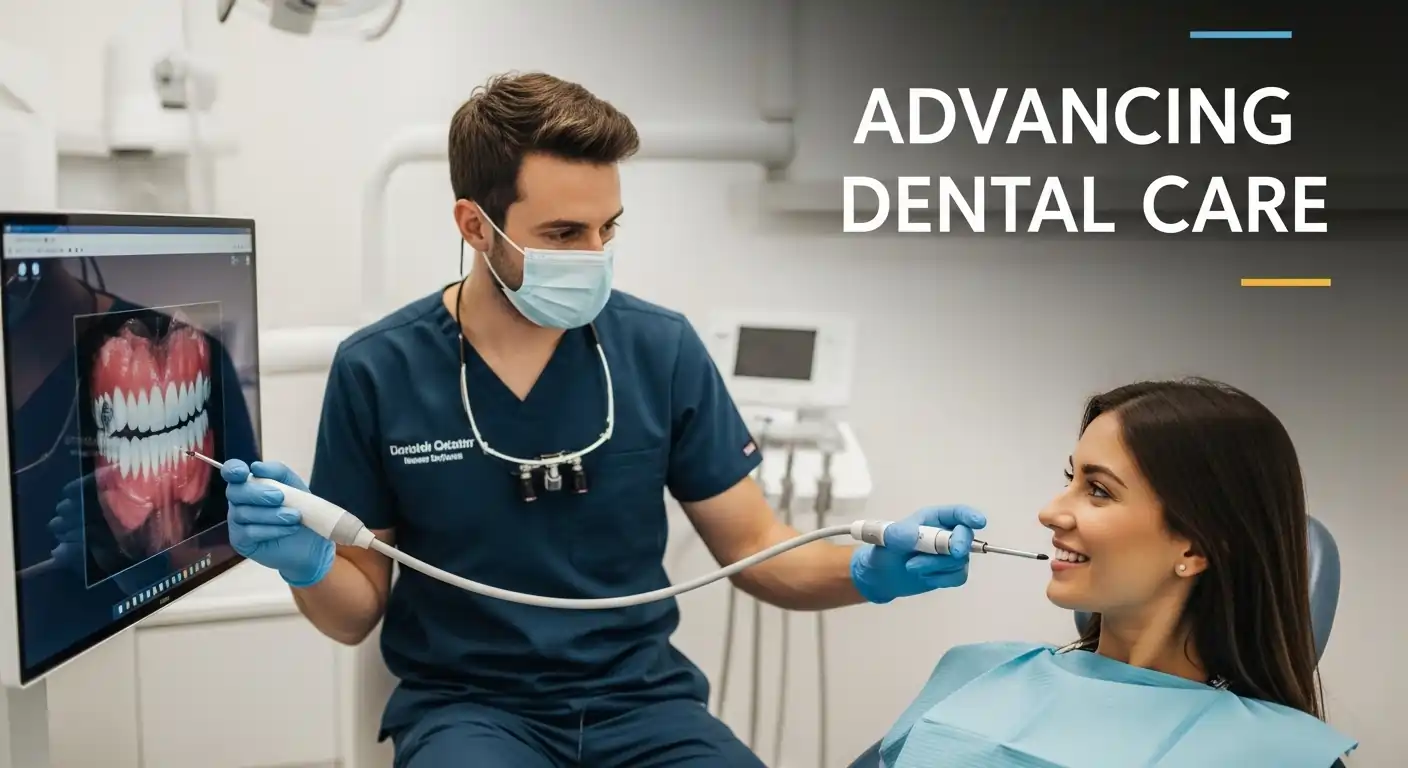
Remember the gagging trays full of putty that dentists used to take impressions? Those are mostly gone now. An intraoral scanner is a small handheld wand. Your dentist moves it around your mouth for a couple of minutes. It captures thousands of data points per second and builds a precise 3D digital model of your teeth.
That model feeds straight into treatment planning software. Your dentist can show you exactly what your teeth look like right now and what treatment will change. Patients understand their own care better when they can see it on screen. That leads to smarter choices and less worry.
CAD/CAM Technology for Same-Day Restorations
Getting a crown used to take two visits and a two-week wait. CAD/CAM technology changed that to one visit.
The dentist scans your tooth. They design the crown on a computer screen. Then they send the file to a small milling machine right there in the office. The machine carves your crown from a ceramic block in about 15 minutes. Your dentist checks the fit and bonds it in place. You leave with a permanent tooth the same day you walked in.
These restorations also fit better because they come from a precise digital scan rather than a hand-poured mold. A better fit means fewer gaps where decay can sneak in later.
Improving Patient Comfort in Modern Dental Care
Dental anxiety is one of the most common reasons people skip the dentist. Some surveys show that about one in three adults feels truly scared of dental visits. That fear comes from real pain, loud noises, and the feeling of having no control.
Advancing dental care takes this problem seriously. The changes made over the last decade are not just about clinical results. They are about how the whole experience feels from the moment you walk in.
Laser Dentistry for Painless Treatments
A dental laser is a focused beam of light that removes decay, cuts soft tissue, and cleans infected areas with very high precision. Because the laser works without physical contact and seals blood vessels as it goes, most patients feel little to nothing during the procedure.
Diode lasers are popular for gum work. Dentists use them for gum contouring, periodontal therapy, and removing small growths. Patients who go through laser gum treatment heal faster, bleed less, and feel far less sore after treatment compared to old-style gum surgery.
For patients who dread the drill, laser dentistry is a real turning point. Many procedures that once needed a needle can now be done with the laser alone. No injection. No numbness for hours. A much calmer visit overall.
Modern Anesthesia Techniques
The standard dental injection has improved a lot. Computer-controlled delivery systems now give anesthetic at a slow, steady rate. Patients barely notice it. The sharp sting from a fast-pushed needle is largely a thing of the past.
Buffered anesthesia adjusts the chemistry of the anesthetic solution. This makes it work faster and more fully. It also helps in areas of infection where regular anesthetic sometimes struggles to take hold.
Nitrous oxide, oral sedation, and IV sedation round out the options for patients with serious anxiety. Any good dentist will walk you through every choice before a single tool comes near your mouth.
Patient-Friendly Dental Clinics
The physical space of a dental office does real psychological work. Research shows that noise, harsh lighting, and clinical smells trigger stress before any treatment even starts.
Smart practices now think carefully about lighting temperature, background sound, and how staff talk to patients. Some offer noise-canceling headphones, screens above the chair, and warm blankets. It sounds simple, but the combination makes a difference. A calm patient is easier to treat and more likely to come back.
Accessibility is also part of comfort. Improving access to dental care for patients with disabilities means wider treatment chairs, clear communication for patients with hearing or cognitive differences, and staff trained in adaptive care. These are not optional extras. They are part of what good dental care actually means.
Preventive Dentistry: The Foundation of Advancing Dental Care
All the technology in this article matters most when it stops problems before they start. Preventive dentistry is not the exciting side of oral care, but it is the most powerful one. A filling costs more than a cleaning. A crown costs more than a filling. An extraction costs more than all of them put together.
The best version of advancing dental care means you need less of it over time.
Importance of Early Detection
The gap between a small problem and a serious one is often a matter of months. A tiny patch of decay found in March is a quick, cheap fix. The same spot missed until November might mean a root canal.
Laser cavity detection tools, AI-assisted X-ray analysis, and digital imaging together make early detection more reliable than ever. AI diagnostic software trained on millions of dental images catches decay, bone loss, and early lesions with accuracy that matches experienced clinicians. For patients, this means fewer things fall through the cracks.
Evidence-based dentistry plays a role here too. Dentists now check their findings against research-backed criteria instead of relying only on instinct. The result is a more consistent level of care across different providers.
Regular Dental Checkups and Cleanings
A professional cleaning removes tartar that builds up even when you brush and floss every single day. Tartar is hardened plaque that no toothbrush can shift. Left in place, it irritates the gums and sets the stage for gum disease. A hygienist removes it in about 45 minutes.
A routine checkup also screens for oral cancer, checks jaw joints, and gives your dentist a chance to ask about anything you have noticed. Most dentists check neck lymph nodes and soft tissue during a standard exam too.
Access to regular dental visits is still unequal across communities. People in lower-income areas and rural regions often go years without a checkup. That gap costs money and health. NHS dental workforce development and community oral health programs are working to close it, but there is still a long way to go.
Fluoride Treatments and Dental Sealants
Fluoride varnish is one of the cheapest and most effective things a dentist can do for your long-term oral health. It bonds to enamel, fills in tiny weak spots, and makes teeth much harder for decay-causing acid to break down. The whole application takes about two minutes.
Dental sealants paint a thin protective layer over the grooves of back teeth. These grooves are where most cavities form in children and teenagers. A well-applied sealant lasts for years and blocks bacteria from ever reaching the surface underneath.
New research in biomimetic dentistry is also producing smarter fluoride compounds and remineralization pastes. These can actually reverse very early decay without any drilling. We are getting closer to a world where catching a cavity early means painting it away instead of cutting it out.
Cosmetic Dentistry and Smile Enhancement
People often treat cosmetic dentistry as something separate from advancing dental care. That gap does not hold up anymore. A misaligned bite causes jaw pain. Cracked or worn teeth lead to sensitivity and decay. And carrying around a smile you feel embarrassed about affects your mental health in very real ways.
Good cosmetic dental work is also functional dental work. Here is what the current options actually look like.
Teeth Whitening Treatments
Professional whitening beats over-the-counter strips in every important way. The bleaching agent is stronger. The custom-fitted trays hold the gel evenly against every tooth surface. And in-office treatments show results within a single session.
Light-activated whitening systems speed up the process so patients see results in under an hour. Take-home custom trays are a slower but equally effective option for people who prefer gradual whitening or have sensitive teeth.
The biggest improvement in recent years is reduced post-whitening sensitivity. Newer formulations include desensitizing agents that protect nerve endings in enamel during and after treatment. Patients who avoided whitening before because of sensitivity often find modern systems completely comfortable.
Dental Veneers and Smile Makeovers
A veneer is a thin shell of porcelain or composite that bonds to the front of a tooth. The material is matched so closely to surrounding teeth that most people cannot spot the difference from a natural tooth, even up close.
Modern veneer work starts with digital smile design software. The patient sees a realistic preview of the finished result before any tooth preparation begins. Changes happen on screen, not in your mouth. That conversation leads to results both the dentist and patient are actually happy with.
A full smile makeover might combine veneers, gum contouring, and whitening for a cohesive, natural-looking result. These are no longer rare procedures. They are available at everyday dental practices at prices that have come down significantly over the past decade.
Clear Aligners for Teeth Straightening
Clear aligners made orthodontic treatment realistic for millions of adults who would never have worn metal braces. They are almost invisible, removable for eating and brushing, and planned entirely through digital scanning.
The planning process itself is one of the best parts. The dentist or orthodontist maps out every step of tooth movement digitally before making the first aligner. You can watch a simulation of your full treatment, from crooked to straight, before you agree to anything. That kind of transparency helps patients stay committed through the whole course.
Modern aligner systems can handle far more tooth movement than early versions could. Complex bite problems and significant crowding cases that once required metal braces are now regularly managed with aligners in the right hands.
The Role of Artificial Intelligence and Digital Dentistry
When people hear artificial intelligence in healthcare, they sometimes picture robots replacing doctors. That is not what happens in dentistry. What AI actually does is handle the pattern-recognition work faster and more reliably, so the dentist can focus on the clinical judgment and patient relationship that only a human can provide.
AI-Assisted Dental Diagnosis
AI diagnostic tools trained on millions of dental X-rays can now flag cavities, bone loss, and early lesions as reliably as an experienced clinician. And they do it every time, without getting tired or distracted.
In a busy practice, a dentist might read dozens of X-ray sets in a single day. Attention naturally drifts. Small things get missed. AI software acts as a second set of eyes, marking anything suspicious so the dentist looks again. Research shows that a dentist working with AI catches more pathology than either the dentist or the AI working alone.
This also creates a useful record. Every image, every flag, every decision gets documented. That data supports better practice over time and tracks disease progression between visits.
Digital Treatment Planning
Digital treatment planning brings imaging data, clinical records, and diagnostic findings together in one place. The dentist can model different treatment options on screen and see how each one plays out before touching a single tooth.
For patients, this changes the whole consultation. Instead of trying to picture what the dentist describes, you see it. Your actual teeth. The actual problem. The proposed fix. The expected result. Questions become more specific. Decisions become more confident.
When multiple specialists are involved, digital planning also cuts down on miscommunication. The orthodontist, the periodontist, and the restorative dentist all work from the same digital file. Treatment runs more smoothly as a result.
Tele-Dentistry for Remote Consultations
Tele-dentistry took off during the pandemic and stuck around because it solves a real access problem. A patient in a rural area with a toothache can now get a proper assessment from a qualified dentist over a short video call. No three-hour round trip needed.
Good tele-dental triage gets patients to the right level of care faster. Real emergencies are seen the same day. Problems that can wait get a scheduled appointment. Patients who just need advice get it without using up an in-person slot.
Many practices now use tele-dentistry for post-treatment check-ins, orthodontic monitoring between visits, and follow-ups after oral surgery. Patient satisfaction is high and outcomes are not affected when it is used for the right cases.
The Future of Advancing Dental Care
What advancing dental care looks like today is already remarkable compared to what existed 20 years ago. But the research running through dental schools and biotech labs right now suggests the next decade will be even bigger.
Regenerative dentistry is the most exciting frontier. Scientists are working on ways to use stem cells and bioengineered scaffolds to grow back damaged tooth structure rather than simply replace it with an artificial material. Early research has shown that certain proteins can trigger the natural regrowth of dentine, the hard inner layer of a tooth. Clinical use is still years away, but the direction is very clear.
Nanotechnology is changing what dental materials can do. Nanoparticle composites are already stronger and more wear-resistant than older filling materials. Nano-scale antimicrobial agents built into restorations actively fight the bacteria that cause secondary decay around existing fillings. Some of these are already in clinical use today.
Wearable oral health sensors are coming. Picture a thin sensor inside a retainer that monitors your saliva, pH levels, and bacterial activity around the clock. When it picks up early signs of trouble, it alerts your phone and your dental practice. Treatment starts before you feel anything at all.
None of this matters if the people who need it most cannot get to it. Advancing dental care also means fixing the systems that deliver it. Better NHS dental workforce development, smarter dental education reform, and more community oral health programs are all part of the same goal. Better tools in well-trained hands, reaching the communities that actually need them, is what good dental care at scale looks like.
Frequently Asked Questions
What is advancing dental care?
Advancing dental care means the ongoing improvement of dental treatments, tools, training, and access so patients get better results with less pain and fewer problems. It covers everything from AI diagnosis and digital scanning to new materials, laser treatments, and workforce reforms that put more dentists in more communities.
How does technology improve dental treatments?
Technology makes diagnoses more accurate, procedures less invasive, and restorations faster and better fitting. Digital X-rays catch problems earlier. Intraoral scanners replace messy mold trays. CAD/CAM machines build crowns in one visit. AI software spots pathology that human eyes might miss on a busy day. Together, these tools raise the standard of what every patient can expect.
Is modern dental care expensive?
It depends on the treatment and where you live. Some advanced procedures cost more upfront. But many technologies reduce the overall cost of care by finding problems early and stopping them from getting worse. NHS reforms and community programs continue to work toward making quality dental care available to everyone, not just those who can afford private treatment.
Who benefits from advanced dental care?
Everyone benefits, but some groups see the biggest difference. Patients with dental anxiety get the most from laser treatment and modern anesthesia. Older adults benefit from better implant and prosthetic options. People with disabilities benefit from accessible clinic design and trained staff. Rural and underserved communities benefit most from tele-dentistry and expanded dental workforce programs.
What is the future of dentistry?
The future sits at the meeting point of biology and technology. Treatments that grow back damaged tooth tissue. AI systems that predict dental disease before it shows up. Sensors that watch your mouth between visits. And a workforce trained to reach every community. The goal is a world where dental disease is caught so early and treated so well that the most serious work becomes truly rare.
Conclusion
Advancing dental care is not a buzzword. It is a real, ongoing change in how teeth are diagnosed, treated, and looked after. And it is backed by solid evidence, growing investment, and clear clinical results.
If you have been avoiding the dentist because of how painful or expensive it used to be, the picture today is truly different. Modern practices have quieter tools, faster visits, less painful procedures, and far better results than dental offices of even 15 years ago.
If you work in dental care, the direction is clear too. The practices that invest in digital tools, keep up with training, and take patient comfort seriously are the ones building lasting trust and strong clinical reputations.
Either way, advancing dental care is moving in one direction: toward more precision, more comfort, better access, and stronger health outcomes for every patient who walks through the door.